

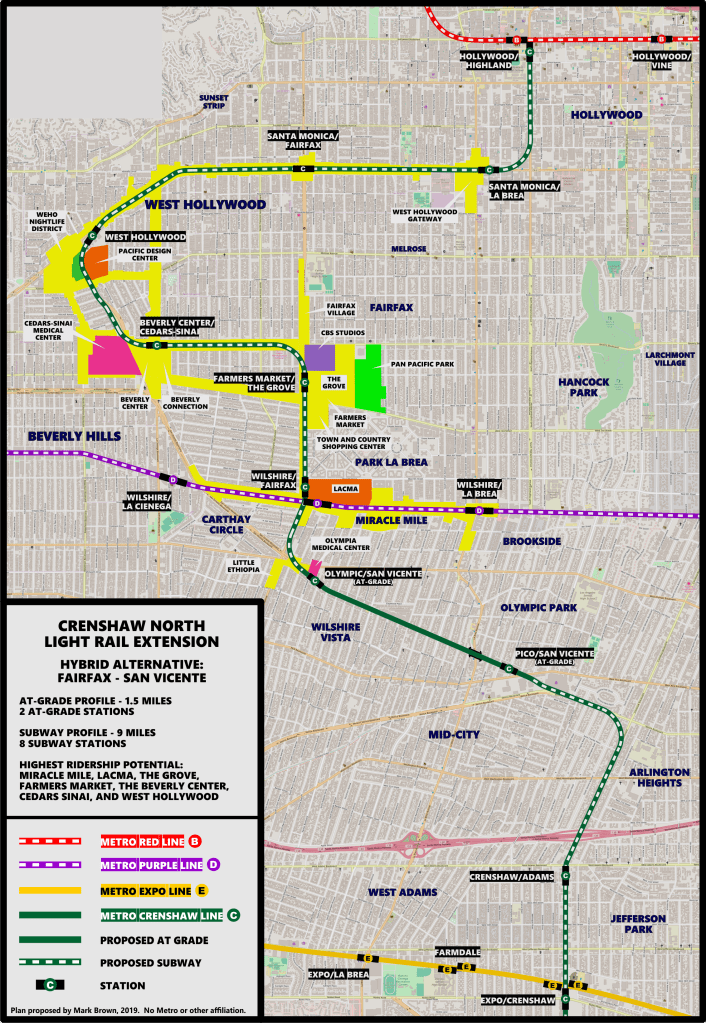
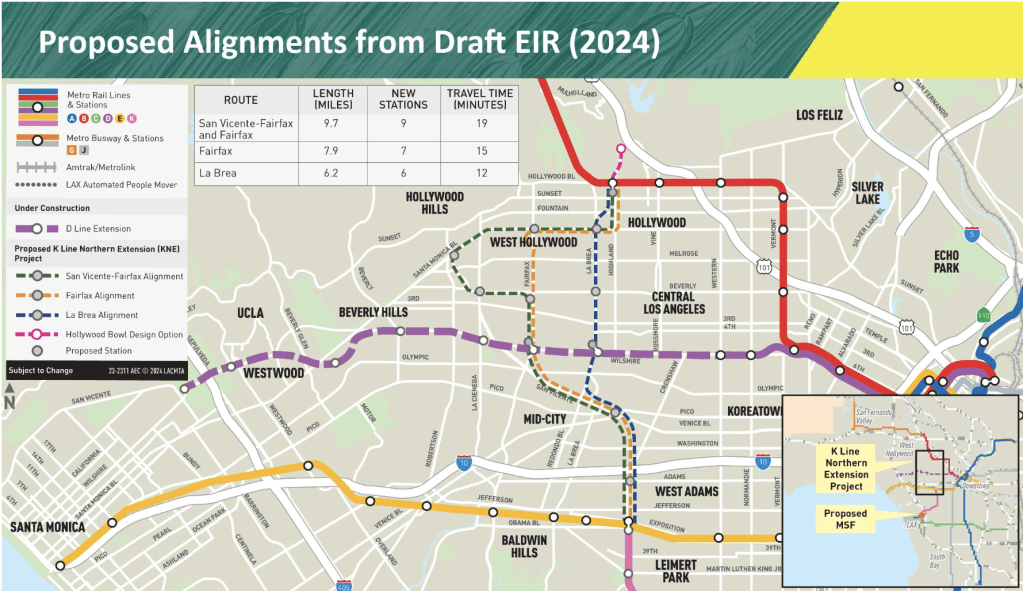
In 2019, Los Angeles Metro conducted public outreach to evaluate alternatives for a northern extension of the Crenshaw/LAX Line (now the K Line), connecting the Crenshaw District to Hollywood. The proposed alignments included La Brea, Fairfax, and San Vicente corridors—each with strengths, but none that fully served the region’s most significant destinations such as The Grove, the Beverly Center, Cedars-Sinai Medical Center, and West Hollywood’s entertainment district.
Drawing on my deep knowledge of the study area’s neighborhoods, travel patterns, and land use, I developed a new Fairfax–San Vicente Hybrid Alignment that blended the strongest elements of the alternatives under study. My objective was to maximize ridership potential by ensuring the extension served as many critical destinations as possible.
I submitted my proposal in a public comment letter to Metro, and to my surprise and honor, Metro staff analyzed my proposal as a standalone alternative alongside the official options. Their findings confirmed what I had envisioned: although the Hybrid Alignment would be the longest and most costly, it would also generate the highest ridership and destination coverage.
Public feedback during subsequent outreach strongly favored the Hybrid Alignment, and it has since earned the formal support of the City of West Hollywood, Los Angeles County Supervisor Lindsey Horvath, and several community organizations. As of August 2025, Metro is expected to adopt a Locally Preferred Alternative (LPA), with the Fairfax–San Vicente Hybrid Alignment emerging as a leading candidate.
This experience has been deeply rewarding—not only because my proposal may shape the future of transit in Los Angeles, but also because it demonstrates the power of thoughtful community participation in major infrastructure planning.
 Mapping by Mark J Brown
Leave a comment